
By Yachtluéur Editors — Last updated December 2025
A yacht interior is not judged in the first minute.
It reveals itself slowly — in the way a door closes, in the silence between footsteps, in how materials feel after a week of use rather than a showroom tour. True quality in luxury yacht interiors is rarely loud. It doesn’t rely on contrast, gloss, or novelty. It relies on decisions made long before the owner ever steps on board.
This is not an article about trends.
It’s about how to recognize real quality in luxury yacht interiors — whether you are chartering, buying, or learning to read yachts with a more trained eye.
A Yacht Interior Is a Language, Not a Look
Many yacht interiors photograph well. Far fewer live well.
Luxury yacht interiors are built to absorb movement, humidity, salt air, and time — all while remaining calm. Unlike residential or hotel interiors, yachts are never truly still. Every material choice, fastening method, and tolerance must account for that reality.
This is why a yacht that looks impressive online can feel strangely fatiguing after two days onboard — while another, visually quieter yacht feels effortless.
The difference is not style.
It is craft.
Materials That Age Well (and Materials That Don’t)
In high-quality yacht interiors, materials are chosen less for appearance and more for behavior over time.
Wood
Not all wood belongs at sea. The best interiors use veneers that are book-matched, stabilized, and finished to resist micro-movement. Solid timber is used sparingly and intelligently. When wood creaks or cabinetry shifts, it’s often a sign of rushed execution rather than “character.”
Stone
Marble and stone must be cut thin, backed properly, and bonded with marine-grade systems. Poor stone work reveals itself through hairline cracks, uneven joins, or excessive weight that affects balance.
Leather & textiles
True marine leather feels supple but not delicate. It resists UV, salt, and abrasion. Stitching matters more than brand — straight seams, consistent tension, and clean terminations are the markers of quality.
Metals
Brushed metals age better than polished ones. On a yacht, glare becomes tiring. The best interiors avoid shine in favor of texture and depth.
Quality materials don’t shout when new — they remain dignified when worn.

The owner’s cabin aboard Sanlorenzo SL110A reveals how luxury yacht interiors communicate quality through calm, not excess.
📷 @sanlorenzoyacht
Craftsmanship Lives in the Seams
If you want to understand yacht interior craftsmanship, stop looking at surfaces and start looking at joins.
Open a drawer.
Look underneath tables.
Notice transitions between materials.
High-end interiors hide complexity. Edges align cleanly. Panels sit flush even when the yacht is underway. Nothing rattles. Nothing flexes.
This level of precision is expensive — not because of materials, but because of time. Craftsmanship is labor, iteration, and refusal to accept “close enough.”
Where Quality Fails First (and Why It’s Rarely Visible at Launch)
This is the part most people never learn, because the failure timeline is slow.
On yachts, interior problems usually don’t begin with a dramatic crack or a visible stain. They begin with paths: moisture paths, vibration paths, load paths — the invisible routes that salt air and motion take through the vessel.
Moisture paths (the quiet destroyer)
Condensation forms where warm interior air meets cooler surfaces behind joinery. The earliest trouble spots are often hidden: behind bulkheads, under sole edges, around bathroom partitions, inside cabinetry backs near hull sides. The question is not whether moisture exists — it’s whether the interior was designed to manage it.
Early warning signs aren’t cinematic. They’re subtle:
-
a door that binds seasonally
-
leather that stiffens near exterior-facing panels
-
a faint change in sound when you tap a bulkhead section
By the time you see discoloration, the system has been failing for a while.
Tolerances under motion (dock-perfect can still be wrong)
Many interiors look flawless at dock. Underway is where truth appears. Poorly resolved interiors are built “tight” rather than intelligently, and tightness becomes friction once the yacht is moving. Micro-movement turns into squeaks, clicks, and small misalignments — the kind that make a yacht feel restless even when it’s visually stunning.
Well-built interiors allow controlled movement. Panels float where they must. Joins are placed where load is predictable. Nothing is forced to behave like a static apartment.
High-touch zones reveal reality fastest
Professionals don’t judge an interior by feature walls. They watch how it wears in the first seasons: thresholds, handrails, drawer edges, door frames, galley corners. Great craftsmanship ages evenly. Weak craftsmanship concentrates damage in one or two places — chips, lifting finishes, darkening joins.
This is where “pretty” and “proper” separate.
Weight, Silence, and Resistance
One of the clearest signals of quality in luxury yacht interiors is physical feedback.
Doors should feel weighted and controlled, not heavy or flimsy.
Drawers should glide without acceleration or resistance.
Handles should not warm excessively in the sun or feel sharp in the hand.
Silence matters. A well-built interior absorbs sound. Footsteps soften. Cabinets don’t echo. When an interior is quiet, it’s rarely accidental — it’s engineered.
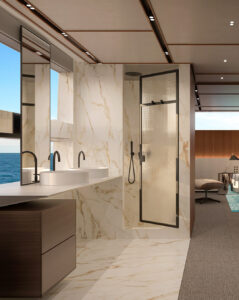
Stone, joinery, and light interact quietly in the Sanlorenzo SL110A — a lesson in luxury yacht interior quality.
📷 @sanlorenzoyacht
Custom vs. Catalog: Where the Difference Really Is
Many yachts claim to be “bespoke.” Fewer truly are.
Custom yacht interiors are not defined by unusual materials or dramatic layouts. They are defined by proportion and intent — spaces designed around how owners actually live.
Catalog interiors reuse modules. Custom interiors resolve problems quietly: sightlines, storage, flow, privacy. You feel the difference when a space makes sense without explanation.
This distinction matters for charter guests too. A yacht with a well-resolved interior feels intuitive even on day one.
The Designer’s Hand vs. the Shipyard’s Habit
Great yacht interiors are the result of collaboration — and tension.
Shipyards prioritize reliability and repeatability. Designers push for refinement and individuality. When the balance is right, the result feels timeless. When it isn’t, interiors can feel either generic or impractical.
The best interiors show respect for the vessel first, decoration second.
How Experienced Eyes Read a Yacht in Ten Minutes
Professionals don’t need a full tour.
They notice:
-
door alignment
-
drawer travel
-
panel gaps
-
noise while moving
-
material transitions
-
wear points already visible
These signals are more revealing than any spec sheet. If an interior feels calm, ordered, and coherent, it usually is.
Why Interior Quality Matters Beyond Aesthetics
Luxury yacht interiors influence more than comfort.
They affect:
-
charter satisfaction (guests relax faster)
-
resale value (timeless interiors age better)
-
maintenance costs (poor craft reveals itself early)
For owners, interior quality is not indulgence — it’s risk management.
For charterers, it’s the difference between a beautiful week and an unforgettable one.
A Final Note on Taste
True luxury is rarely explained.
It is sensed.
The best yacht interiors don’t impress immediately. They reveal themselves gradually, through ease, silence, and the absence of friction. They allow guests to forget the object and focus on the experience.
That is the real measure of quality.
If you learn to read these quiet signals, you’ll never look at luxury yacht interiors the same way again.
For readers interested in how this philosophy translates into specific materials and long-term investment choices, our guide to luxury yacht interior investment pieces explores which elements continue to reward owners long after launch.