
By Yachtluéur Editors — Last updated February 2026
There is a moment in every charter conversation when the numbers stop feeling abstract.
Not because the broker changed the yacht.
Not because the destination changed.
But because the client realizes that the yacht charter cost by size is not a linear scale. It is a structural shift.
A 30-meter yacht and a 70-meter yacht do not represent more or less luxury in simple terms. They represent entirely different operational systems — different crews, different fuel behavior, different marina access, and different weekly charter costs.
Understanding yacht charter cost by size is the single clearest way to understand how charter pricing actually works.
For a broader overview of total charter pricing, see our complete guide on how much it costs to charter a yacht in the Mediterranean.
This guide explains, calmly and precisely, what different yacht sizes really cost — and why.
Quick Answer: Yacht Charter Cost by Size (Weekly Charter Fee)
Before going deeper, here is the clear structural overview.
| Yacht Size | Weekly Charter Cost | Typical Crew | Guest Capacity |
|---|---|---|---|
| 30 meters | €40,000 – €90,000 | 4–6 crew | 8–10 guests |
| 50 meters | €150,000 – €300,000 | 9–12 crew | 10–12 guests |
| 70 meters | €400,000 – €700,000 | 15–20 crew | 12 guests |
| 100 meters | €900,000 – €1,800,000+ | 25–35 crew | 12–14 guests |
These ranges represent base charter fees. Operational expenses scale alongside size, particularly in regions like the Mediterranean, where charter pricing follows established operational patterns. See our full breakdown of Mediterranean Sea charter pricing in our Mediterranean yacht charter cost guide.
But the most important insight is this:
Yacht charter cost by size does not increase gradually. It increases structurally.
Each size class introduces a different operational category.
Why Yacht Charter Cost Changes So Dramatically With Size
From the outside, the difference between a 30m yacht and a 70m yacht may appear visual — length, decks, volume.
Operationally, the difference is exponential.
Three core systems shape charter cost at different yacht sizes:
Crew structure
Crew is the single largest operational factor.
A 30m yacht operates with a compact, highly versatile crew of 4–6.
A 70m yacht requires departmental specialization — bridge crew, engineering team, interior staff, chefs, and deck teams.
Each additional crew member increases not only salary but also provisioning, accommodation logistics, and operational complexity.
This is why costs accelerate beyond 50 meters.
Fuel consumption and propulsion scale
Fuel usage does not increase in direct proportion to yacht length.
It increases based on displacement, propulsion power, and onboard systems.
A 30m yacht may consume hundreds of liters per hour underway.
A 70m yacht consumes several times that — even when cruising conservatively.
Fuel scaling is one of the quiet structural forces behind overall pricing at larger sizes.
Marina access and berthing economics
Larger yachts operate in a more constrained marina ecosystem.
Berths capable of accommodating 70m+ yachts are limited — especially in Monaco, Cannes, Saint-Tropez, and Portofino. Our Monaco yacht guide explains berth scale, marina access, and yacht movement in detail.
Scarcity creates pricing pressure.
This is why berth access itself becomes part of the charter price curve, particularly during peak Mediterranean season.
30m Yacht Charter Cost: Entry Into True Private Superyacht Charter
Weekly charter cost: €40,000 – €90,000
A 30-meter yacht represents the entry point into fully crewed private yacht charter.
At this size, guests experience:
-
Full professional crew
-
Dedicated chef and steward service
-
Private itinerary flexibility
-
True separation from hotel-style travel
Operationally, 30m yachts offer the best balance between capability and efficiency.
They can access smaller anchorages and ports easily, maintain moderate fuel consumption, and operate with relatively lean crew structures.
For many experienced charter guests, this size range provides the highest efficiency relative to yacht charter cost by size.
50m Yacht Charter Cost: The Structural Transition Point
Weekly charter cost: €150,000 – €300,000
At 50 meters, yachts transition into full superyacht operational class.
This size introduces:
-
Larger crew teams with defined departmental roles
-
Substantially increased interior volume
-
Dedicated engineering staff
-
Expanded guest areas and amenities
The operational shift is immediate.
Fuel consumption increases. Crew requirements increase. Berthing logistics become more complex.
This is where the pricing curve begins accelerating faster than visual size alone would suggest.
This size class is often chosen by experienced charter guests who want the stability and operational smoothness of larger yachts without entering ultra-large operational scale.
70m Yacht Charter Cost: Full Superyacht Operational Scale
Weekly charter cost: €400,000 – €700,000
A 70-meter yacht operates as a fully developed floating hospitality system.
At this level, operational structure includes:
-
Specialized engineering teams maintaining propulsion and onboard systems
-
Dedicated interior departments managing guest experience
-
Complex logistics for provisioning, fuel planning, and routing
These yachts often include:
-
Multiple tenders
-
Extensive toy inventories
-
Cinema rooms, gyms, beach clubs
-
Advanced stabilization and navigation systems
At this scale, charter cost reflects not only the yacht itself, but the operational ecosystem required to sustain it.
100m Yacht Charter Cost: Ultra-Large Yacht Category
Weekly charter cost: €900,000 – €1,800,000+
Yachts above 100 meters exist in an entirely different operational category.
These are rare assets, often designed with:
-
Multi-deck interior environments
-
Extensive crew departments exceeding 30 members
-
Aviation-grade engineering systems
-
Private-residence-level accommodation standards
Operationally, these yachts function more like private cruise ships than recreational vessels.
Fuel logistics, provisioning, crew operations, and marina access all operate on specialized infrastructure.
At this level, yacht charter cost by size reflects the reality that the yacht itself is a mobile hospitality system requiring continuous professional management.
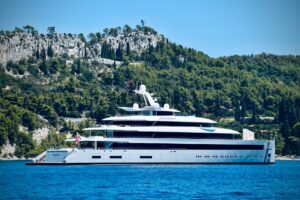
Yachts above 100 meters operate as fully autonomous floating systems with dedicated engineering, crew departments, and infrastructure.
The Most Important Insight: Size Determines Operational Behavior
Many first-time clients assume that yacht charter cost by size reflects comfort differences alone.
In reality, size determines operational behavior.
Larger yachts:
-
Require longer planning horizons
-
Have more constrained marina access options
-
Operate with higher fixed operational load
-
Move with different fuel efficiency characteristics
This influences not only charter cost, but itinerary design and routing flexibility.
Understanding yacht charter cost by size allows clients to select the correct operational scale for their charter goals.
How Hidden Costs Scale With Yacht Size
Operational expenses scale alongside yacht size.
Fuel consumption increases.
Crew provisioning increases.
Berth costs increase.
This is managed through the APA (Advanced Provisioning Allowance), which funds operational expenses during charter. See our complete explanation of what APA means in yacht charter and how it works.
Larger yachts do not simply cost more to charter — they require more complex operational support throughout the charter period.
This is why the base charter price and operational cost structure are inseparable.
These operational expenses are explained in full detail in our guide to the hidden costs of yacht charter.
Choosing the Right Yacht Size Is a Strategic Decision
Which Yacht Size Is Right for Your Charter?
This is the real question behind how yacht size shapes charter cost.
Not how much each category costs — but which operational scale aligns with your week.
Because the correct yacht size is not determined by budget alone. It is determined by how you intend to use the yacht.
30m yachts: operational freedom and efficiency
A 30-meter yacht is often the most operationally flexible category.
These yachts can:
-
access smaller anchorages comfortably
-
move efficiently between coastal destinations
-
operate with lower fuel consumption relative to larger vessels
-
adapt quickly to itinerary changes
For guests who prioritize exploration — moving between Saint-Tropez, Corsica, Sardinia, or the Amalfi Coast with freedom — this size offers exceptional balance.
Costs remain controlled, while operational freedom remains high.
This is why many experienced charter clients continue to select yachts in the 30–40m range even after chartering larger vessels.
Not because they cannot charter larger yachts.
Because this size often operates with the least friction.
50m yachts: the structural sweet spot
Around 50 meters, something important happens.
You enter full superyacht scale — without yet entering ultra-large yacht constraints.
At this size, yachts offer:
-
significantly expanded interior volume
-
highly stable cruising behavior
-
larger crew teams ensuring smoother onboard service
-
advanced guest amenities and layout flexibility
But they still retain enough marina accessibility and operational efficiency to maintain itinerary flexibility.
This is why 50m yachts are often considered the structural equilibrium point in yacht charter cost by size.
They deliver the psychological and experiential presence of a true superyacht — without introducing the operational rigidity of ultra-large vessels.
Many of the most sought-after charter yachts globally exist in this size category for this reason.
70m yachts: maximum onboard experience, reduced operational spontaneity
Above 70 meters, the charter experience shifts again.
These yachts deliver exceptional onboard environments — but they operate within a narrower logistical framework.
At this size:
-
berth planning becomes more critical
-
certain smaller ports and marinas become inaccessible
-
routing decisions require more advanced coordination
-
operational planning horizons extend
None of this reduces the experience onboard.
In fact, onboard comfort and capability reach their highest levels.
But the yacht itself becomes a more structured operational system.
The pricing reflects this transition — not just financially, but operationally.
These yachts are ideal when the yacht itself is the primary destination.
100m yachts: private maritime estates
At 100 meters and above, yachts operate as fully autonomous environments.
These vessels are rarely selected for simple coastal cruising.
They are selected when:
-
privacy must be absolute
-
onboard capability must be complete
-
the yacht itself becomes the central environment
Operational planning becomes precise and deliberate.
Every movement is intentional.
At this level, yacht charter cost by size reflects the reality. These yachts are not simply larger.
They operate as private maritime estates.
The real objective is operational alignment, not maximum size
The most successful charters are not those with the largest yachts.
They are those where yacht size aligns with charter behavior.
A well-matched 50m yacht delivering seamless routing, easy anchorage access, and operational efficiency will often provide a smoother experience than a larger yacht operating at the limits of marina and routing constraints.
This is the structural truth behind charter cost scaling.
Not every charter benefits from maximum scale.
Every charter benefits from the correct scale.
Final Perspective: Yacht Size Is the Structural Foundation of Charter Cost
Every charter decision ultimately traces back to size.
Crew. Fuel. Berths. Routing. Operational logistics.
All scales from this single variable.
Understanding yacht charter cost by size gives charter clients clarity — not just on budget, but on how the charter will function operationally.
When size is chosen correctly, the entire charter week becomes smoother.
Not because the yacht is larger.
Because the operational system is aligned with the experience itself.
read next
How much does it cost to charter a yacht in the Mediterranean?
Hidden Costs of Yacht Charter – What Brokers Rarely Explain
The Best Port to Start a French Riviera Yacht Charter — Monaco, Cannes or Antibes