

The teak deck is warm under your feet.
While you watch the sunrise, the crew sets up the aft deck for breakfast.
In the galley below, chefs unpack produce flown in from Provence.
At the helm, the captain quietly checks fuel burn for the next hop to Corsica.
None of this is included in your base charter fee, yet it all happens seamlessly because of Advance Provisioning Allowance (APA).
You may find yourself asking “what is APA in a yacht charter?” or wondering why your broker asks for an extra 30–40% on top of the charter fee. In this guide, you’ll discover what APA is, how it shapes your experience, and how to use it to your advantage.
What is APA in a yacht charter?
Advance Provisioning Allowance (APA) is a pre-paid onboard expense account to cover all the variable running costs of your yacht charter. The amount is calculated as a percentage of the base charter fee.
APA funds elements that shape guests’ experience, including:
-
Fuel for the yacht and tenders
-
Food and beverage provisioning
-
Marina and port fees
-
Communications and utilities
-
Special requests arranged by the crew
APA is collected before you board. During the trip, the captain manages and tracks expenditures, deducting them from the APA. If expenses exceed the allowance, you may be asked to top up. Or, if the APA has not been fully spent by disembarkation, you’ll be refunded the remaining amount.
Why APA benefits you
Luxury yachts operate like private floating hotels.
Every voyage is unique: one guest might island-hop at 22 knots with premium champagne, while another might anchor for days with local wines.
APA is designed to honor the variety of experiences guests desire while keeping pricing transparent and fair. Instead of having to pause to pay for each expense as it is incurred, guests can rely on the captain to handle it for them. The itinerary becomes flexible, and guests can customize their journey without added financial stress.

APA covers provisioning and hospitality during a yacht charter.
How much APA to expect
Yacht type plays a key role in calculating APA.
For sailing yachts, the APA is typically 20–30% of the base charter fee. Provisioning is the main driver of the APA because fuel burn is low.
For displacement motor yachts, the APA is typically 30–35% due to steady generator use and moderate fuel usage.
For fast-planing motor yachts, the APA is typically 35–40% or more since high speeds require high fuel consumption.
A €100,000 weekly charter could therefore carry a €30,000–€40,000 APA.
What APA covers in detail
Fuel
Fuel is the biggest swing factor.
As speed increases, fuel burn increases exponentially. Fast passages and frequent tender trips consume far more fuel than gentle cruising and anchoring.
Fuel also powers generators and water toys.
To manage fuel usage effectively, plan efficient routes, cruise at economical speeds, and cluster tender trips.
Food & beverages
APA covers provisioning tailored to your preferences.
Costs scale with quality and quantity.
Premium items like caviar and vintage wines make for an expensive menu.
Specific dietary requests — from vegan to kosher — can cost more to source in remote locations.
To keep provisioning efficient, provide a detailed preference sheet early and approve substitutions.
Marina & port fees
On a multi-day charter, disembarking to explore coastal towns is commonplace.
APA covers marina and port fees, which vary depending on location, yacht size, and time of year.
Premier ports, such as Port Hercule in Monaco, Vieux Port and Port Canto in Cannes, and Marina Grande in Capri, have much higher rates than remote ports. Prime berths in Riviera marinas during peak season can cost thousands per night.
Marinas charge by the length overall (LOA) of a vessel, and extra-wide yachts often pay more.
Communications & utilities
APA enables crew to scale the yacht’s utility consumption to match your lifestyle.
It funds various utilities aboard, such as satellite internet, laundry, electricity, and air conditioning. At port, it covers shore power, freshwater hookups, and waste pump-outs.
Water toys
APA often funds water toys. Certain water toys may be included as standard equipment on a yacht.
In other cases, you may need to arrange toy rentals through the crew. APA may not cover security deposits or damage waivers for some toys, so check with your captain.
Special requests
Even special requests can be covered by APA.
Think helicopter transfers, private guides, flowers, decorations, event tickets, and spa therapists.
As long as special requests are arranged through the crew, APA typically funds them.
What APA does not cover
Because APA can cover so many expenses, misconceptions often arise.
Think of APA as funding “running costs.”
Note that it is distinct from the base charter fee, which includes foundational expenses, such as the yacht rental, professional crew, and insurance.
Security deposits are not running costs, so APA does not cover them.
The value-added tax (VAT), local taxes, and crew gratuity are also separate expenses because they are “after-service” or statutory items.
How APA works before, during, and after
Before the charter
Most of the financials are settled before your trip.
Your broker will quote the APA alongside the base charter fee. Then, usually 4–6 weeks before embarkation, you’ll transfer funds with your payment.
Once you fill out a preference sheet, the captain will use it to plan berths and order food and fuel.
During the charter
APA allows you to enjoy your trip without financial stress.
The captain manages APA spending and logs receipts daily.
If desired, you can request a running balance.
Changes in itinerary, last-minute parties, or unexpected fuel prices can push spending beyond the deposit — in that case, you’ll be asked for a top-up.
After the charter
When your trip comes to an end, the captain will provide a detailed final account.
Any unspent funds are refunded promptly, often within a few business days.
If costs exceeded the deposit and you didn’t top up during the trip, you settle the difference.
Example APA breakdown — €100,000 motor-yacht charter
Consider a €100,000 motor-yacht charter with an APA of €35,000.
| Item | Cost (€) | Notes |
|---|---|---|
| Fuel (yacht + tender) | 12,000 | Two long passages + daily tenders |
| Food & Beverages | 11,500 | Premium menus, special wine list |
| Marinas & Port Fees | 4,200 | Three Riviera marinas incl. event night |
| Comms & Utilities | 1,800 | Wi-Fi, satellite phone, laundry |
| Special Requests | 2,000 | Airport transfers + private guide |
| Total APA Spent | 31,500 | Out of €35,000 APA deposit |
| Refund to Guest | 3,500 | Returned within days of disembarkation |
If, for example, the yacht moves at a slower pace and anchors more often, fuel might drop to €7–8k, and the refund increases accordingly.
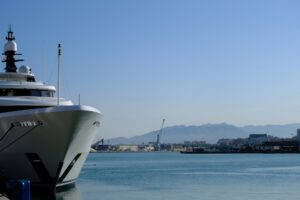
Marina and port fees during a yacht charter are typically paid from the APA — Advance Provisioning Allowance.
APA vs. all-inclusive models
APA charters significantly differ from all-inclusive charters.
| Feature | APA Charter (Advance Provisioning Allowance) | All-Inclusive Charter |
| Base Fee | Lower, covers yacht + crew | Higher, includes estimated consumables |
| Flexibility | High: fuel, menus, marinas per guest choice | Moderate: fixed inclusions |
| Trans- parency | Receipts, refunds, top-ups | Less itemized |
With APA, you see exactly where your money goes while you customize your trip. Similarly, APA offers unique flexibility: you can change plans mid-week without renegotiating costs.
All-inclusive charters, on the other hand, keep planning simple and provide financial certainty. They bundle the yacht, crew, fuel, route, provisioning, and toys into the base fee. Guests know the total cost before stepping aboard.
The better type of charter comes down to preference. All-inclusive charters are ideal for guests wanting predictability and simplicity, while APA charters suit guests wanting customization and control.
Smart tips to master your APA
You can make the most of any charter by using APA wisely.
When filling out your preference sheet, list brands, bottle prices, and portion sizes — the more detail, the better the provisioning will be.
Before your trip, ask for an estimated breakdown of how the APA will be spent. Compare fuel, food, and marinas.
During your charter, review expenses mid-week. A five-minute check-in with the captain will help you avoid surprises and adjust plans if necessary.
Also keep speed and distance in mind. Cruising at 12 knots instead of 20 can halve fuel burn.
For flexibility and peace of mind, retain a cushion. Set 5–10% of the APA aside for spontaneity.
It is important to communicate changes early. If you’d like to add guests, use extra toys, or host a big event, let the crew know.
Common questions
1. Can APA be paid by credit card or must it be wired?
Deposits are almost always by bank transfer. Some yachts accept cards for small top-ups with a processing fee.
2. Is APA standard worldwide?
The mechanism is standard for crewed charters; only the percentages and what’s typical vary.
3. Is APA mandatory on every yacht?
Most crewed yachts use it; some smaller or niche charters do not.
4. How do currency conversions affect APA?
APA is held in the contract currency to avoid double conversions or loss of value.
5. Do I still need to pay an APA if the yacht is staying in port?
Yes. A static yacht burns less fuel, but marina fees and provisioning costs remain.
A pathway to custom journeys
APA is not a mysterious surcharge.
It is a transparent operating account that empowers the captain to tailor the charter to guests’ wishes, from specific dietary preferences to special requests.
It untethers trips from rigid itineraries. Spontaneous marina nights, changes of course, and secluded anchorages all become possible.
In the end, APA transforms yacht charters into bespoke, frictionless voyages.
Beyond APA — designing a charter
APA is only one of many considerations when planning a trip.
Thoughtful planning makes your time at sea feel effortless. After choosing the right destination, explore our latest guides on charter costs, etiquette, and packing lists. For refined, one-to-one support when planning your charter, visit our Charter Concierge.
read next
Yacht Charter Cost Breakdown: Base Fee, APA, VAT & Real Weekly Cost
Hidden Costs of Yacht Charter – What Brokers Rarely Explain