There is a particular kind of disappointment that only happens on an expensive holiday: everything is beautiful, nothing is technically wrong, and yet the trip never quite becomes the one you imagined.
A yacht charter can produce exactly that feeling.
You wanted long afternoons in quiet water. Instead, the week revolves around restaurant reservations and busy harbours. Or you imagined evenings ashore, walking through old towns after dinner, only to discover that the itinerary places most of the emphasis on remote anchorages. Perhaps every destination is spectacular, but the yacht spends so much time moving between them that nobody has quite enough time to enjoy being anywhere.
None of these is necessarily a bad charter. It may simply be the wrong Mediterranean.
The best Mediterranean yacht destinations are not interchangeable versions of the same luxury holiday. The French Riviera, Sardinia, the Greek islands, Croatia, the Balearics and the Turkish coast offer different relationships between the yacht, the coastline and the people travelling aboard.
And that relationship matters more than the number of famous places on the itinerary.
Before deciding where to charter a yacht in the Mediterranean, it is worth asking a less glamorous but far more useful question:
What do you actually want your days to feel like?
The Best Mediterranean Yacht Destinations at a Glance
There is no universal winner. The right cruising region depends on whether you want to spend your time swimming, exploring, entertaining, sailing, dining ashore or simply enjoying the yacht without a demanding schedule.
| Cruising region | What it does particularly well | What to consider |
|---|---|---|
| French Riviera | Iconic ports, restaurants, beach clubs and social life | Peak-season crowds, berth demand and a more public atmosphere |
| Sardinia | Beautiful water, striking coastline and sophisticated summer life | Exposed conditions in some areas and restrictions around protected waters |
| Corsica | Wild landscapes, contrasting coastlines and a less polished atmosphere | Greater route sensitivity and fewer convenient stops in some stretches |
| Amalfi Coast and Capri | Dramatic arrivals, Italian culture and memorable time ashore | Congestion, limited harbour options and weather-dependent access |
| Greek islands | Variety, island culture and multiple distinct cruising grounds | Wind and distances vary enormously between regions |
| Croatia | Island-hopping, historic towns and a strong mix of sea and shore | Busy popular harbours in high summer |
| Balearic Islands | Beaches, clear water, restaurants and contrasting island personalities | Protected marine areas, seasonal crowding and inter-island distances |
| Turkish Riviera | Pine-lined bays, historical coastline and unhurried coastal cruising | The experience depends heavily on the chosen stretch and yacht style |
This is a starting point, not a ranking. Each region can deliver several different kinds of holiday, and none should be reduced to a single stereotype.
The useful distinctions emerge when we look at how a week actually unfolds.
First, Decide What Kind of Yacht Holiday You Want
A destination is often chosen for its reputation. A successful itinerary is chosen for its rhythm.
Consider two couples planning a week aboard a crewed motor yacht.
The first group enjoys dressing for dinner, discovering restaurants, arriving in recognisable ports and occasionally seeing friends ashore. They want the yacht to be their private home within a lively Mediterranean social world.
The second group wants breakfast at anchor, swimming before lunch, an afternoon with no particular plan and perhaps one excellent dinner ashore during the week.
Both groups may describe their ideal holiday as luxurious. But the same itinerary is unlikely to satisfy them equally.
Six factors make the difference.
The balance between sea and shore. Some cruising grounds are particularly rewarding because of what happens after the tender reaches land. Others are at their best when nobody feels any urgency to leave the yacht.
The natural pace of the coastline. A sequence of nearby islands or coastal towns can allow a relaxed itinerary. More ambitious passages may make sense for guests who enjoy travelling, but not for those who see cruising time as something to minimise.
The character of the anchorages. A beautiful bay is not automatically a comfortable or permitted overnight anchorage. Exposure, seabed, vessel size, environmental protection and weather all matter.
The importance of the evening. For some guests, dinner in town is the centre of the day. For others, the best evening is spent aboard, with the shoreline gradually disappearing into darkness.
The season. The same destination can feel entirely different in June and August. The social atmosphere, marina availability, weather patterns and pressure on popular bays all change.
The yacht itself. A large motor yacht, a sailing yacht and a catamaran do not experience the same coastline in the same way. Draft, speed, range, tender capability and guest preferences affect what makes sense.
This is why choosing a Mediterranean yacht charter destination should come before falling in love with a particular seven-day route.
The map cannot tell you how the week will feel.
French Riviera: When the Shore Is Part of the Experience
The French Riviera makes its strongest argument not through isolation, but through proximity.
Monaco, Cannes, Antibes and Saint-Tropez each offer a different version of Mediterranean life. A yacht allows guests to move between them while keeping the same private space, the same crew and the same sense of continuity.
The experience is as much about arrival as departure.
A morning at anchor might be followed by lunch ashore, an afternoon back on board and dinner in a town whose atmosphere is entirely different from the one visited the previous evening.
Monaco brings a particular concentration of yachting culture, architecture, restaurants and events. Cannes combines a working maritime setting with the Croisette and access to the Lérins Islands. Antibes has its own relationship with the sea, shaped by the old town and Port Vauban. Saint-Tropez shifts the emphasis towards the village, Pampelonne and the surrounding coastal social scene.
But the Riviera is not only its famous names. Villefranche-sur-Mer, Cap Ferrat and the islands farther west offer different ways to experience the same coastline.
Choose the French Riviera if you want a yacht holiday with a strong connection to restaurants, culture, shopping, events and life ashore.
Think twice if your idea of escape depends on finding an almost empty anchorage every afternoon in August.
The Riviera can offer privacy. It simply does not make privacy effortless everywhere, all the time.
Sardinia: When the Water Becomes the Main Event
Sardinia offers something different.
Along the Costa Smeralda, the relationship between pale granite, low Mediterranean vegetation and extraordinarily clear water can make the coastline itself feel like the destination.
Porto Cervo provides the polished social counterpoint: marina life, dining and a well-established summer yachting scene. But treating Sardinia as little more than Porto Cervo misses much of its appeal.
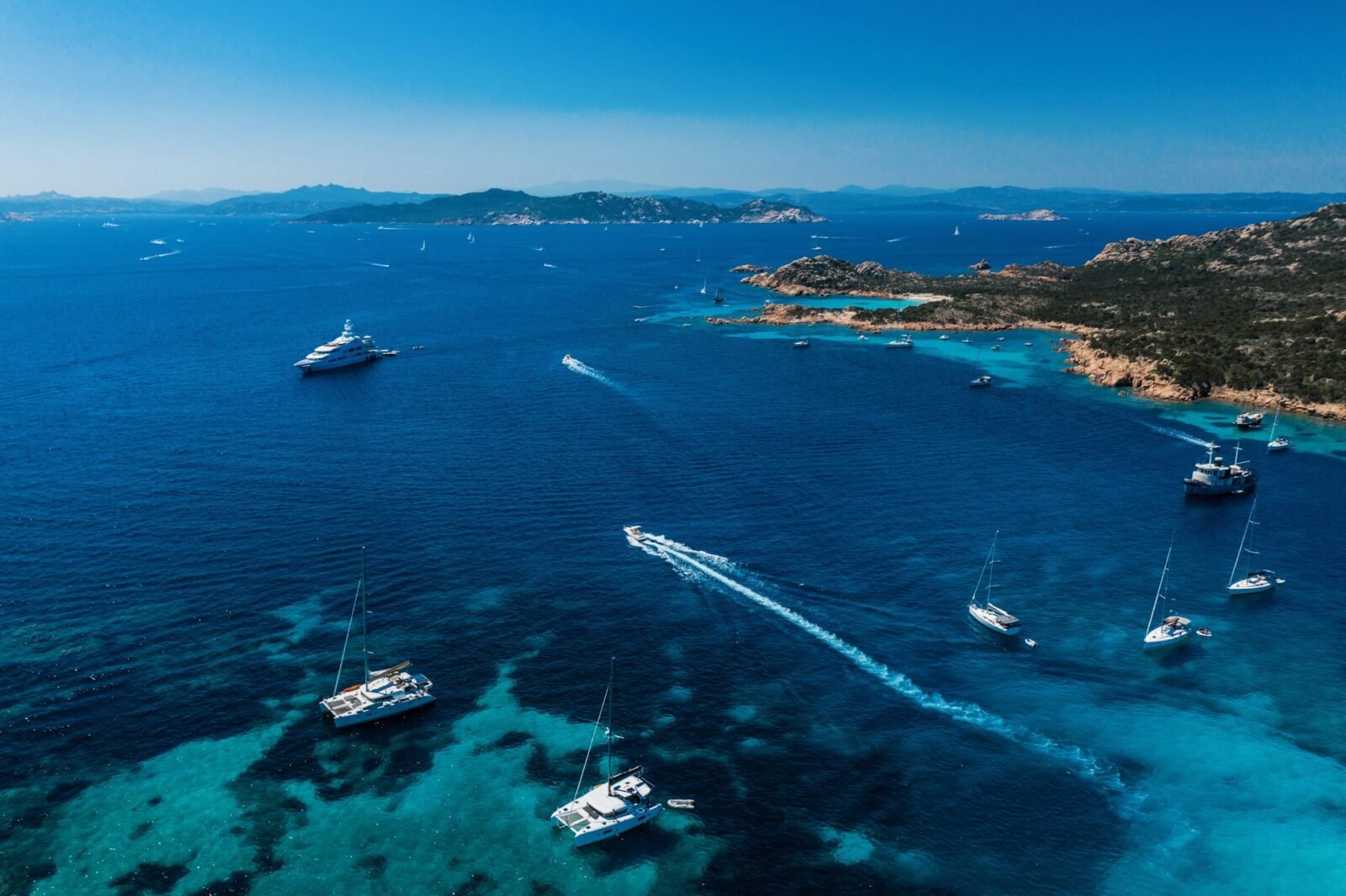
The La Maddalena archipelago is one of the region’s great attractions, with islands and channels that reward time spent on the water rather than a constant succession of town visits.
It also demonstrates why beautiful destinations require serious planning. La Maddalena is a national park with permits and specific rules governing navigation, mooring and anchoring. These are not details to discover after arriving in a bay.
Sardinia is especially rewarding for guests who enjoy swimming, waterside lunches, coastal scenery and a day that does not need an elaborate programme.
There is a complication, however. Northern Sardinia and the waters around the Strait of Bonifacio can be affected by strong winds. A well-planned charter needs flexibility rather than an insistence on visiting every photographed beach.
Choose Sardinia if the quality of the water, the coastline and time aboard matter more than collecting famous towns.
Think twice if you expect every desired anchorage to be accessible on a fixed schedule regardless of conditions.
The best Sardinian yacht day may be the one in which almost nothing happens beyond the bay.
Corsica: A More Untamed Mediterranean
Corsica is often mentioned alongside Sardinia, but the two islands should not be treated as substitutes.
Corsica has a more rugged presence. Mountains rise behind the coastline, and the island’s geography gives different stretches of shore markedly different personalities.
Bonifacio is among the Mediterranean’s most dramatic maritime arrivals, its limestone cliffs and elevated old town creating a powerful contrast with the water below. Calvi offers another relationship between harbour, citadel and surrounding landscape. Farther along the western coast, the scenery becomes increasingly defined by cliffs, inlets and protected natural areas.
Corsica rewards people who appreciate a sense of landscape and discovery more than a polished social circuit.
It also asks for respect. Some coastal stretches offer fewer convenient alternatives, and exposed passages can influence the itinerary. Protected areas have their own restrictions, which must be checked before planning access or anchoring.
Choose Corsica if you want dramatic scenery, a strong sense of place and a charter that feels less centred on the luxury circuit.
Think twice if your priority is an uninterrupted sequence of beach clubs, large marinas and predictable shore arrangements.
Corsica’s appeal is partly that it refuses to behave like a resort.
Amalfi Coast and Capri: When Arrival Is the Experience
Some Mediterranean coastlines reveal themselves gradually. The Amalfi Coast makes an immediate impression.
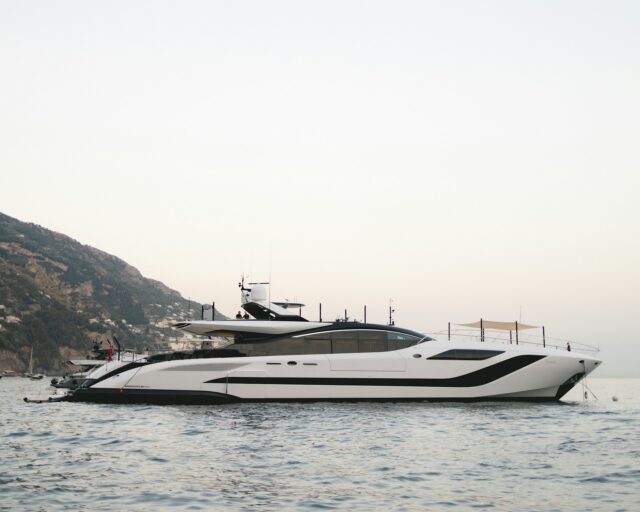
The villages appear almost improbably attached to steep terrain. From the water, Positano becomes a composition of buildings, colour and cliffs. Capri offers another kind of drama, with its distinctive rock formations, busy waterfront and life above the harbour.
This is a coastline where arriving by yacht can change the perspective entirely.
It is also a place where the romantic image and the practical reality require careful reconciliation.
Popular landing points can become congested. Harbour capacity is limited in certain locations, and tender access may depend on sea conditions and local arrangements. A famous restaurant reservation does not guarantee an easy journey ashore.
The solution is not to avoid the Amalfi Coast. It is to build the itinerary around what is genuinely worth the effort.
A day centred on one memorable stop can be more satisfying than three rushed arrivals.
Choose the Amalfi Coast and Capri if you value Italian coastal culture, architecture, food and extraordinary scenery.
Think twice if you want a week defined primarily by quiet anchorages and minimal shore logistics.
Here, the yacht can make an iconic destination feel more personal. It cannot make the coastline empty.
Greece: Choose the Cruising Ground, Not Just the Country
Greece may be the clearest example of why a broad destination label is not enough.
A charter in the Ionian Islands is a different proposition from a week in the Cyclades. The Saronic Gulf offers another set of possibilities, as do the Dodecanese and Sporades.
The Cyclades deliver some of the most recognisable images of the Greek islands: whitewashed settlements, exposed landscapes and towns that have become destinations in their own right.
But their summer cruising conditions deserve attention. The Meltemi, a seasonal northerly wind in the Aegean, can influence routes and comfort, particularly during the summer months. A powerful yacht does not eliminate the experience of rougher conditions for guests.
The Ionian Islands present a contrasting landscape. Corfu, Lefkada, Kefalonia and neighbouring islands offer greener scenery and a different pattern of passages and anchorages. They are often a more natural fit for guests seeking a relaxed island-hopping holiday.
The Saronic Gulf can appeal to those wanting island character without building an ambitious route deep into the Aegean.
The important decision is not simply whether to charter a yacht in Greece.
It is which Greece.
Choose the Greek islands if you want a strong combination of island culture, swimming, varied landscapes and opportunities to shape the itinerary around your preferred pace.
Think twice before choosing the Cyclades solely for their famous names if your group is especially sensitive to motion or expects an inflexible itinerary in peak summer.
A quieter Greek cruising ground may give you more of the holiday you actually wanted.
Croatia: When the Journey and the Towns Work Together
Croatia has a particular advantage: the Adriatic coast offers a remarkable combination of islands, historic settlements and established yachting infrastructure.
A charter can move between swimming stops and towns where the evening is part of the attraction.
The Dalmatian coast brings places such as Split, Hvar, Vis, Korčula and Dubrovnik into the planning conversation. But their value lies in how they are combined, not in how many can be fitted into one week.
Vis offers a different mood from Hvar. Korčula has a different relationship with the sea than Dubrovnik. Some stops deserve an evening ashore; others may be better experienced as part of a quieter day.
Croatia can be particularly appealing to mixed groups. Guests who want swimming and relaxation can enjoy the yacht, while those who prefer history, architecture and restaurants have meaningful reasons to go ashore.
The caveat is popularity. In high summer, famous harbours and anchorages can be busy, and the Adriatic is not immune to significant weather changes.
Choose Croatia if you want a balance of island-hopping, coastal towns, swimming and cultural exploration.
Think twice if you expect the best-known stops to feel secluded during the busiest weeks.
The strongest Croatian itinerary gives each place a reason to be there.
Balearic Islands: Four Islands, Four Different Personalities
It is tempting to reduce the Balearics to Ibiza.
That would be a mistake.
Mallorca offers a substantial coastline with contrasting landscapes, established marinas and opportunities to combine secluded-feeling bays with towns and restaurants.
Menorca is generally associated with a quieter atmosphere, although its popular coves are hardly undiscovered.
Ibiza brings a distinctive social and cultural energy, with nightlife and dining that can become a central part of the charter.
Formentera is particularly appealing for its beaches and water, making it an attractive complement to time spent around Ibiza.
Together, they offer an unusually broad range of holiday styles within one island group.
But that does not mean every island belongs on the same one-week itinerary. Distances, weather and the desire to spend time actually enjoying the destinations should determine the route.
Environmental protection matters here, too. The waters around Ibiza and Formentera include protected Posidonia seagrass habitats. Responsible anchoring is not optional, and local restrictions must be respected.
Choose the Balearics if your group wants beautiful water and beaches alongside restaurants, nightlife or a choice of quieter island atmospheres.
Think twice if you are planning to visit all four main islands simply because they appear close together on a map.
A better Balearic holiday may involve fewer islands and longer afternoons.
Turkish Riviera: When the Coast Invites You to Slow Down
The Turkish Riviera offers a different interpretation of Mediterranean yachting.
Around Göcek and Fethiye, pine-covered hills descend towards bays and inlets, creating a setting that can lend itself to a slower rhythm. Farther west, Bodrum adds a more visible luxury and cultural scene, while other stretches of the coast offer historical sites and smaller coastal communities.
Turkey also has a distinctive maritime tradition in the gulet: a crewed wooden vessel associated with leisurely coastal journeys.
A gulet charter and a contemporary motor yacht are not identical experiences. That distinction matters when choosing the vessel as much as the destination.
For guests who enjoy spending time at anchor, swimming, dining aboard and occasionally exploring ashore, parts of the Turkish coast can offer an appealing balance.
The mistake would be to assume that the entire Turkish Riviera has one atmosphere. Bodrum and Göcek do not offer the same kind of week.
Choose the Turkish Riviera if you are drawn to coastal scenery, historical character and a holiday with room to slow down.
Think twice if you are choosing purely on an assumption that Turkey will automatically be quieter or cheaper. The vessel, season, location and arrangements still determine the experience.
The Hidden Variable: How Much of Your Week Will You Spend Moving?
There is a reason ambitious itineraries look so convincing before a charter begins.
On a map, the Mediterranean seems wonderfully connected. A few famous ports, an island crossing and several beautiful anchorages can appear to fit neatly into seven days.
But the line between two destinations does not represent the whole experience.
A passage involves preparation, departure, travel and arrival. Conditions may change. A berth may not be available when expected. Tender operations can take longer than anticipated. Guests may simply prefer to stay somewhere they have begun to enjoy.
This is where the distinction between a good itinerary and a good holiday becomes important.
A route should not be judged by how many destinations it includes, but by what remains of the day after travelling between them.
For some guests, cruising itself is a pleasure. They enjoy watching the coastline change and spending time underway. For others, the yacht is most valuable when stationary, with the sea immediately accessible.
Neither preference is more sophisticated.
They simply require different plans.
Before agreeing to a Mediterranean yacht itinerary, ask three questions:
- How many days involve substantial passages rather than short repositioning?
- Which stops are essential, and which can be removed without damaging the experience?
- If weather changes the route, is there still a satisfying holiday available?
The third question is particularly revealing.
A beautiful itinerary should survive a change of plans.
When to Charter: The Best Destination Changes With the Season
Mediterranean yacht charter season is often described as running broadly from late spring into early autumn.
That is useful as an introduction, but it does not tell you enough to choose a region.
June can offer a different balance of atmosphere, temperature and availability from the busiest weeks of July and August. September can be appealing for guests who prefer a less intense social calendar, although individual venues and seasonal services may operate differently as the season progresses.
The effect is not uniform across the Mediterranean.
The French Riviera has an event-driven rhythm alongside its summer holiday season. Sardinia’s most prominent social destinations become particularly active in peak summer. In Greece, seasonal wind patterns can influence the appeal of different island groups. Croatia’s popular harbours experience strong summer demand. The Balearics combine beach and nightlife seasons with marine protection considerations.
There is no single month that is objectively best for every region and every guest.
A better approach is to choose the desired atmosphere first, then identify the dates most likely to support it.
If your priority is the full social scene, a busy week may be part of the attraction.
If your priority is quiet water and flexible plans, the same week may be precisely what you want to avoid.
Weather remains variable, whatever the calendar suggests. Seasonal patterns are planning tools, not guarantees.
The Yachtluéur Mediterranean Destination Test
Before choosing between the best Mediterranean yacht destinations, consider five questions.
1. Would you rather have a remarkable lunch ashore or an uninterrupted afternoon at anchor?
If the shore experience is central, start with the French Riviera, Amalfi Coast, Ibiza or selected Croatian and Greek routes.
If time in the water matters more, look closely at Sardinia, parts of the Balearics, the Ionian Islands or the Turkish coast.
2. Does your group enjoy travelling between places?
If everyone enjoys the journey, a more varied itinerary may be rewarding.
If guests prefer to settle into the day, favour a compact cruising area rather than an ambitious regional circuit.
3. What kind of evening feels most like a holiday?
A lively harbour, a memorable restaurant, a quiet town or dinner on the aft deck are four different answers.
The right destination should make your preferred evening feel natural, not logistically exhausting.
4. How important is privacy?
If privacy is essential, think beyond famous names.
A well-chosen quieter cruising ground may be more satisfying than an iconic destination at its busiest. But privacy also depends on the particular bay, yacht, season and conditions.
5. What are you unwilling to compromise?
For some, it is swimming in clear water. For others, excellent food, a vibrant social atmosphere, cultural exploration or avoiding long passages.
Identify the one or two things that genuinely matter.
Then allow the rest of the itinerary to support them.
Three Different Guests, Three Different Shortlists
Consider a family travelling with children who want swimming, watersports and relaxed afternoons. A carefully planned Ionian, Croatian or Sardinian itinerary could make more sense than a week designed around the Riviera’s most fashionable ports.
Now consider a group of friends who want restaurants, beach clubs and evenings ashore. The French Riviera or an Ibiza-focused Balearic charter may be a more natural fit, even if another region offers quieter anchorages.
Finally, imagine a couple who have already visited the major Mediterranean hotspots and now want a different sense of place. Corsica, a less familiar Greek cruising area or the Turkish coast might be more compelling than repeating the obvious names.
These are not fixed prescriptions. The specific yacht, dates, weather and guest preferences could change each recommendation.
That is the point.
The best destination is not the one that wins the most categories. It is the one that wins the categories you care about.
What Not to Do When Choosing a Mediterranean Yacht Charter
The most common mistake is not selecting a bad destination.
It is allowing the destination’s reputation to make the decision.
Saint-Tropez is famous, so it must be included. Capri is iconic, so it deserves a stop. Mykonos is recognisable, so the route should reach it.
Sometimes those decisions are exactly right.
Sometimes they create a week that is more impressive to describe than enjoyable to experience.
Avoid building an itinerary around photographs without considering the journey between them. Avoid treating a protected anchorage as freely accessible without checking the rules. Avoid assuming a larger or faster yacht makes weather irrelevant. And avoid believing that a higher charter budget automatically solves the problem of choosing the wrong region.
A yacht provides freedom, but good planning gives that freedom a useful shape.
The most thoughtful charter itineraries leave enough room for the unexpected: an anchorage worth staying in, a town that deserves another evening, or simply a morning when nobody wants to go anywhere.
How to Choose the Right Cruising Region
Start with the experience, not the destination.
If you want glamorous coastal life and exceptional time ashore, the French Riviera deserves a place near the top of your list.
If you want the water and coastline to dominate the week, consider Sardinia.
If you want rugged landscapes and a less polished atmosphere, look towards Corsica.
If dramatic scenery and Italian coastal culture matter most, consider Amalfi and Capri.
If you want island variety, narrow Greece down to the cruising ground that suits your comfort and pace.
If you want historic towns woven naturally into an island-hopping holiday, Croatia is a strong candidate.
If your group wants beaches and a choice between lively and quieter atmospheres, examine the Balearics.
And if the ideal holiday involves unhurried coastal days with opportunities for cultural discovery, consider the Turkish Riviera.
Then test your shortlist against the season, the yacht, the distances and the people travelling with you.
There is no need to see the entire Mediterranean in one charter. There is not even a need to see every famous place within a single region.
The real luxury is arriving somewhere that feels right—and having enough time to enjoy it.
The best Mediterranean yacht destinations are not necessarily the places everyone wants to visit.
They are the places that make the kind of week you want possible.
Beyond the Destination
Once you know where you want to cruise, the next decision is how to make the charter work: the yacht, the itinerary and the practical arrangements that turn a destination into a coherent week.
Continue with Yachtluéur’s Charter collection to explore the decisions behind a well-planned Mediterranean yacht holiday.
read next

Yacht Charter Cost by Size: What 30m, 50m, 70m, and 100m Yachts Really Cost
How much does it cost to charter a yacht in the Mediterranean?