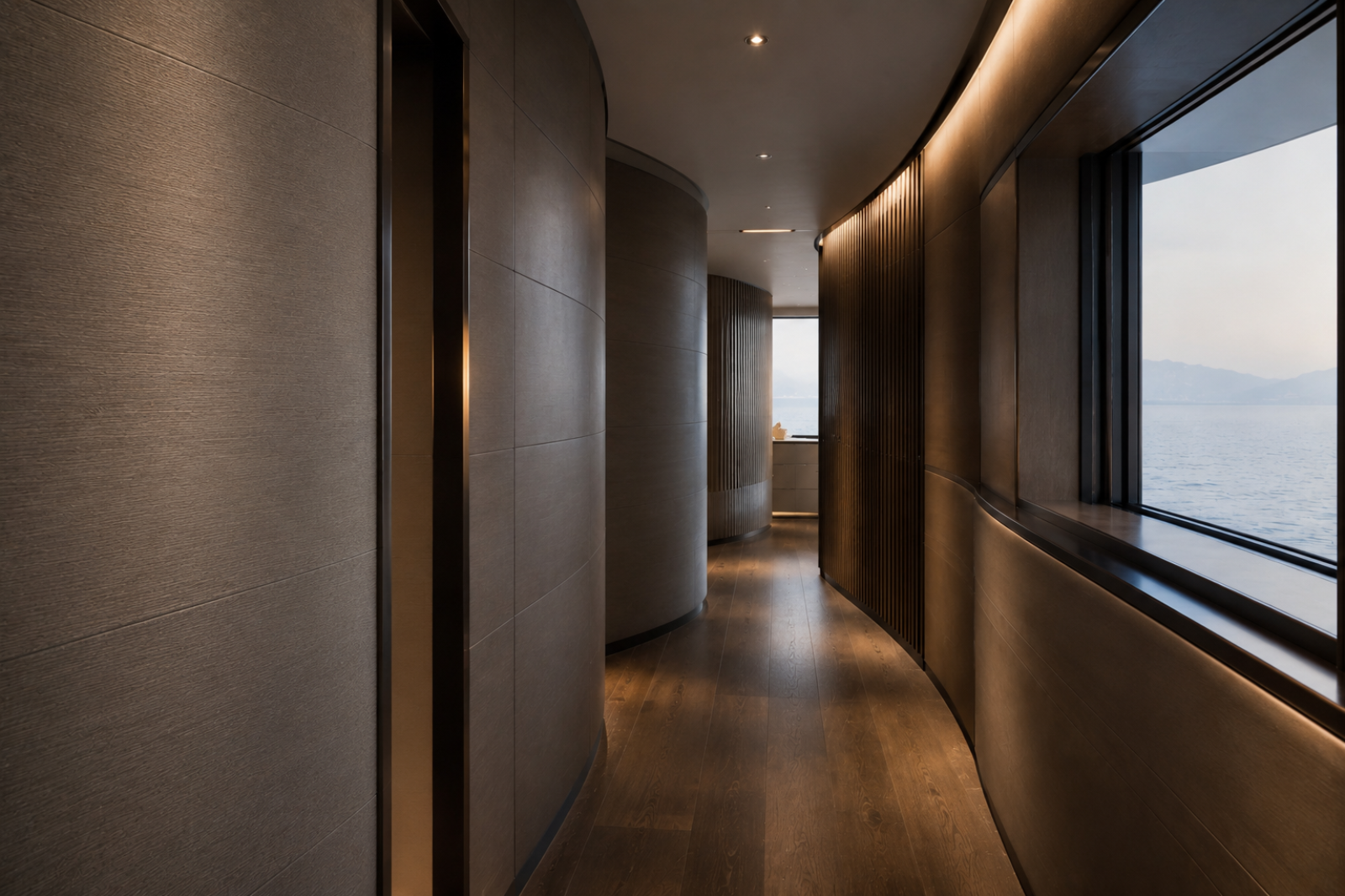
A guest steps onboard a yacht for the first time.
The materials are beautiful. The furniture is refined. The view is extraordinary.
Yet after a few hours, something feels slightly off.
People cross paths awkwardly. Conversations drift into spaces that should feel private. Movement between decks feels less intuitive than expected. Nothing appears wrong, but the experience never fully settles.
This is where yacht layout design becomes more than arrangement.
It becomes psychology.
A yacht can be beautiful in photographs and difficult in motion. The difference often has little to do with materials or decoration. It comes down to how people move through the vessel, how privacy is protected, and how space responds to life onboard.
The best yacht layout design is rarely noticed directly.
Instead, it creates a feeling of calm.
Why Yacht Layout Design Matters More Than Most People Realize
Many people evaluate a yacht floor plan by counting cabins, comparing square footage, or reviewing deck features.
Those elements matter, but they do not explain how a yacht actually feels.
A successful yacht interior layout controls movement, privacy, service, and social interaction. It determines whether guests feel relaxed or interrupted. It influences whether spaces feel generous or constrained, regardless of the yacht’s actual size.
A good yacht layout design is not the one that fits the most rooms.
It is the one that removes the most friction.
The finest yachts create an experience where movement feels natural. Guests rarely need to think about where to go next. Private spaces remain protected. Public spaces remain welcoming. Service happens efficiently without becoming visible.
That is not decoration.
That is planning.
The Real Question: Where Does Friction Appear?
The easiest way to understand yacht design psychology is to look for friction.
Every weak layout contains it.
Every strong layout reduces it.
Movement Friction
Movement friction occurs when circulation feels awkward.
A guest should be able to move from cabin to saloon, from saloon to aft deck, or from beach club to upper deck without hesitation.
When corridors feel confusing, stairs interrupt flow, or routes require unnecessary detours, the yacht begins to feel smaller than it really is.
Good yacht circulation feels effortless.
Bad circulation constantly asks for decisions.
Privacy Friction
Privacy on board is more complex than distance.
A cabin can be physically separated yet still feel exposed.
The placement of doors, corridors, staircases, and sightlines all influence whether people feel protected or observed.
The best yacht privacy design allows owners and guests to retreat naturally without feeling isolated.
Privacy should feel available, not forced.
Service Friction
Luxury depends heavily on invisible operations.
When crew movement interferes with guest movement, friction appears immediately.
Housekeeping routes, galley access, provisioning pathways, and technical circulation all influence the guest experience.
A guest may never consciously notice good service routes.
They will always notice the poor ones.
Social Friction
Yachts serve multiple purposes.
People gather together. People seek solitude. People move between those states throughout the day.
Strong yacht layouts provide options.
Guests can join a conversation, enjoy a quiet corner, or watch the sea without feeling disconnected from the rest of the vessel.
The goal is flexibility.
Not every moment should happen in the same space.
Visual Friction
Visual friction appears when sightlines fail.
Entrances feel uncertain. Views become blocked. Private areas become unintentionally visible.
Great yacht interior planning considers what people see before they consider what people touch.
Because perception begins long before contact.
The Four-Zone Model of a Calm Yacht
Most successful superyacht layouts follow a pattern, whether intentionally or not.
They organize life into four distinct zones.
Public Zone
The public zone includes areas such as the main saloon, dining spaces, aft deck, beach club, and entertainment decks.
These spaces encourage gathering and openness.
They are designed for arrival, interaction, and views.
Semi-Private Zone
Semi-private spaces often include sky lounges, reading areas, observation lounges, and sheltered exterior seating.
These spaces allow social connection without demanding participation.
Many of the most comfortable moments on a yacht happen here.
Private Zone
The owner’s suite, guest cabins, dressing rooms, and personal retreats belong to the private zone.
These areas should feel protected from noise, movement, and interruption.
The best yacht cabin layout designs understand that privacy is not simply separation.
It is psychological comfort.
Service Zone
Crew quarters, laundry areas, storage, galleys, and technical pathways form the service zone.
These spaces support everything else.
Luxury on a yacht often depends on how elegantly these zones avoid colliding.
Guest Flow: The Invisible Luxury of Movement
Guest flow is one of the least discussed aspects of yacht design.
It is also one of the most important.
Consider arrival.
A guest boards from a tender. Bags arrive. Crew provides guidance. The guest explores the yacht for the first time.
Every transition creates an impression.
Can guests locate social spaces naturally?
Can they find cabins without confusion?
Can they move between decks without crossing operational areas?
Can they reach the water easily?
Can they return from swimming without disrupting the interior?
When guest flow works, nobody praises it.
They simply feel relaxed.
That is the highest compliment a layout can receive.
For readers, not audiences.
Yachtluéur letters are released selectively — when observation becomes reference, and reference becomes worth keeping.
Thank you!
You have successfully joined our subscriber list.
Privacy: The Difference Between Space and Peace
Many yacht brochures celebrate space.
Few discuss peace.
Privacy is not measured solely in square metres.
It is measured through sound, visibility, and control.
A well-designed owner suite feels protected without feeling disconnected. Guest cabins feel quiet without feeling isolated. Social spaces remain active without overwhelming nearby private areas.
Privacy on board is not isolation.
It is the ability to disappear without leaving the yacht.
That distinction matters.
Why Crew Flow Defines Luxury
One of the strongest indicators of yacht quality is invisible service.
Exceptional crew flow allows hospitality to feel effortless.
Meals arrive smoothly. Cabins remain organized. Supplies move discreetly. Housekeeping operates without interruption.
None of these experiences happens by accident.
They are the result of careful yacht space planning and intelligent service routes.
A yacht feels calm when service happens without becoming scenery.
The guest experiences comfort.
The crew experiences efficiency.
Both outcomes depend on layout.
Interior Layout and Deck Layout Must Work Together
Many people think about interior and exterior spaces separately.
The best yachts never do.
The relationship between saloon and aft deck, owner suite and private terrace, beach club and swim platform all influence how the vessel feels.
A strong yacht deck layout extends the interior experience rather than competing with it.
Movement should continue naturally between inside and outside.
The sea should feel connected to the architecture.
When these spaces work together, the yacht feels larger than its dimensions suggest.
Common Yacht Layout Mistakes
Even expensive yachts can suffer from poor planning.
Some of the most common yacht layout mistakes include:
- Too many cabins for the available volume
- Owner suites are placed for prestige rather than comfort
- Crew routes crossing guest routes
- Staircases creating bottlenecks
- Public spaces located too close to sleeping areas
- Exterior decks disconnected from interior circulation
- Social spaces lacking quiet alternatives
Most yacht layout mistakes are not visible in photographs.
They reveal themselves after movement begins.
How to Read a Yacht Floor Plan Like an Insider
A yacht floor plan reveals far more than room placement.
Before evaluating finishes or styling, ask:
- Where do guests arrive?
- How does crew circulation work?
- Can guests reach cabins easily?
- Is privacy protected?
- Do public spaces connect naturally?
- Are stairs intuitive?
- Does the owner suit avoid major traffic routes?
- Does the beach club connect logically to social areas?
- Can people gather and retreat with equal ease?
The answers often reveal more than any rendering.
Why Layout Matters for Long-Term Value
A larger yacht does not automatically create a better experience.
Many smaller yachts feel more comfortable because their layout is more intelligent.
Good flow improves everyday use, customer satisfaction, resale appeal, and long-term enjoyment.
Length tells you the scale.
The layout tells you how that scale is lived.
That is why experienced owners often discuss floor plans before discussing finishes.
The arrangement of space shapes every day that follows.
The Yachtluéur Test
A simple question can reveal the quality of almost any yacht layout.
Does the yacht feel calmer the longer you stay onboard?
If movement becomes easier, if privacy feels natural, if social spaces feel balanced, and if the vessel gradually disappears into the experience itself, the layout is probably working.
The finest yacht layouts rarely draw attention to themselves.
They remove resistance.
Closing
A yacht is never simply a collection of rooms.
It is a sequence of movements, pauses, thresholds, encounters, and returns.
The best yacht layout design understands that luxury is not created by adding more space.
It is created by using space intelligently.
When flow feels natural, privacy feels protected, and movement feels inevitable, the architecture begins to disappear.
What remains is the experience.
Beyond the Floor Plan
A successful yacht layout design does more than organize movement. It shapes how a yacht feels. To understand how flow, privacy, light, and restraint create a deeper sense of comfort, read: What Makes a Yacht Interior Truly Luxurious.
read next
Yacht Interior Design Mistakes: The Hidden Signs of a Trend-Driven Interior
Yacht Stonework: Marble, Quartzite, Onyx — What Survives on a Yacht